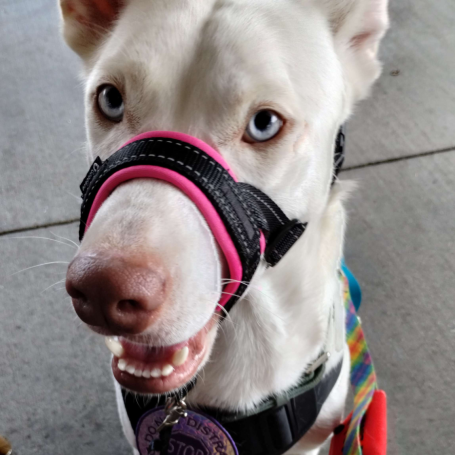
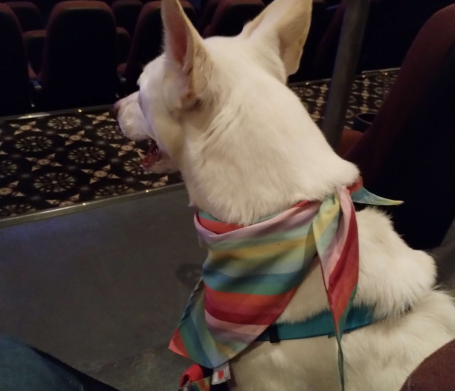
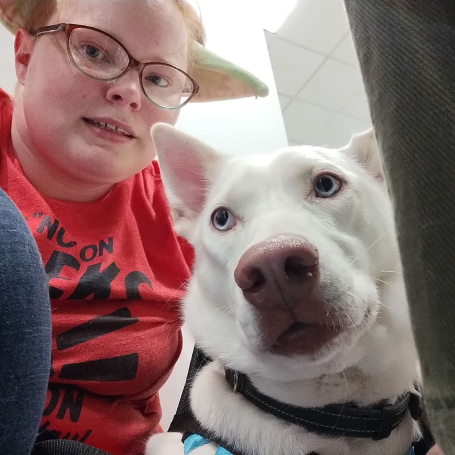
(All photos above belong to Studio Säyre; these are Tobi's service dog and gear.)
Service Dog Gear FAQ
Below are the answers to our most-asked questions.
My dog is for emotional support. Do you offer emotional support gear?
No, and for a very specific reason: emotional support animals do not have any public access rights in the US. We don't offer anything for ESAs (Emotional Support Animals) for this reason. This includes but isn't limited to collars, leashes, and vests.
What makes a service dog?
A service dog is defined by the ADA (Americans with Disabilities Act) as a dog that is individually trained to assist a disabled individual with one or more life-altering tasks. This could be anything: from guiding a blind person around obstacles, to alerting a deaf individual to an alarm clock, to detecting allergens in food, to turning lights on and off for an individual with limited mobility.
Emotional support and comfort are not tasks, as explicitly stated by the ADA.
Only dogs and miniature horses are protected by the ADA. As such, we do not provide gear for any other species, including cats, monkeys, and birds.
Wait, what about Miniature Horses?
Miniature Horses are recognized under the ADA as service animals.
We do not have access to an acceptable living animal model or equine vet, and as such, we do not offer gear for Minis. This decision was made for the safety of the animals.
Tasks Miniature Horses are known to perform include mobility assistance, guide work for the blind, and wheelchair assistance. The prevalence of Miniature Horses as service animals typically is very limited, due to their preference among those who cannot work with dogs for religious reasons, those who cannot work with dogs due to severe allergies, and those who simply require a more robust animal.
While we cannot provide support for these wonderful creatures, we do recognize them as a very powerful option.
It takes around eight months to train a guide horse, and they can live for over thirty years. Guide horses can be placed around age two, meaning that you can work with a guide horse for upwards of twenty five years! Compare this to a guide dog, which is also typically placed at age two, but retires between ages eight and eleven. You typically get about three times longer working with a guide horse than you do a guide dog.
However, this comes with drawbacks. If you thought the harassment was bad for a service dog, service horses will face far worse barriers of entry. They also require a yard of substantial enough size for grazing, and on top of vet bills you will also be facing farrier bills and equine dentist bills, as well as hay and forage, blanketing, and barn expenses. Gear for a service horse is also more expensive.
If you are local, and would like to see about reaching out to us via email to do some design work with the accompaniment of your vet, we would be interested in learning more about Miniature Horse equipment possibilities and working alongside you to develop something that works for you and is safe. At this time, we are unable to travel outside of Spartanburg County to do this, and anyone interested who is further afield would need to travel to us.
Important note regarding service dog gear and in-training dogs
As stated on our dog gear page, anyone knowingly purchasing service dog gear from our studio to misrepresent their dog as a service dog or service dog in training is committing a crime under U.S. law.
Anyone purchasing these items for an in-training dog needs to keep their state's laws in mind. If you are unaware of your state's laws for in-training dogs, please click the link below. This link goes to the "Table of State Service Animal Laws" by Michigan State University's Legal and Historical Animal Center. This is a reliable, regularly updated resource.
List of service animal and service dog in training laws by state
We often get asked when you should remove the "in-training" markers from your dog. The general guideline is when the dog is reliable at tasking without being distracted, and when you're relying on your dog more than you are correcting them, they are ready. This could take some dogs six months, and some dogs two years. There's no true universal answer and we recommend you work with your trainer or an evaluator to determine when your dog is ready to remove the labels.
And, if a dog ever needs to be retrained... having those labels on-hand is a good idea.
Can you put the Service Dog text in Spanish/French/another language?
Absolutely! Please contact us with the preferred text in both languages.
We do not offer translation services; you must provide your own translation.
We CAN put different languages on the left and right side panels of our vests.
A quick reminder of the Orange Leash/Orange Collar rule!
Orange leashes and collars are not just for hunting dogs during deer season. The Orange Collar rule is a common indicator of a dog trained to assist the deaf (also called a hearing dog). Here is a quick overview of the Orange rules for states listed under AnimalLaw.info, but please be sure to check your local regulations.
Connecticut requires an orange leash and collar for service dogs not wearing a harness in public;
Maryland recognizes the orange leash and may have an orange collar tag schema for service dogs;
Mississippi recognizes orange leashes as a sign of guide and hearing dogs;
Oklahoma appears to reserve orange collars for deaf or hard of hearing handlers of hearing dogs;
Tennessee appears to have a road-crossing rule involving stopping for guide dogs and dogs on orange leashes;
Virginia recognizes the orange leash for in-training dogs and hearing dogs.
ESSAs (Emotional Support Stuffed Animals)
We've been asked twice if we provide anything for ESSAs, or Emotional Support Stuffed Animals.
The answer is simply, no.
We DO do scale model tack for dogs including model service dog tack, but we do not offer any full-sized or mini-sized emotional support tack or gear.
This falls under our Emotional Support clause. We get that this bothers people, but if the real animal is not allowed in public, we have had to take a stance to not make scaled down gear on the off-chance that it is being used to take a real animal into public, including small dogs or cats.
We strive to only represent real service animals in our gear.
Thank you for understanding.
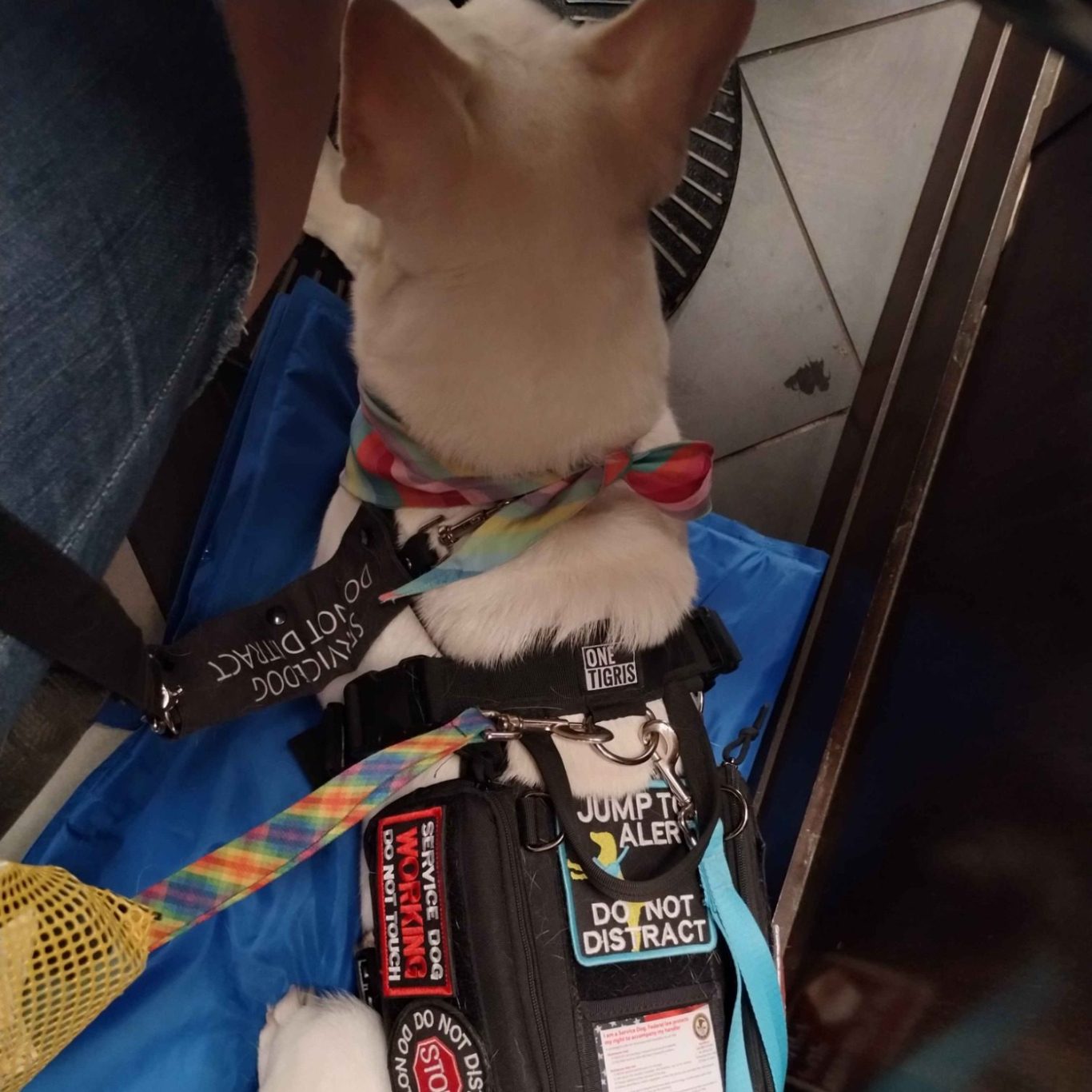
Not all jobs are glamorous... helping her human write in a coffee shop is sometimes part of the job!
But the mat was cool, the vibes were good, and there was whipped cream, so she wasn't complaining...